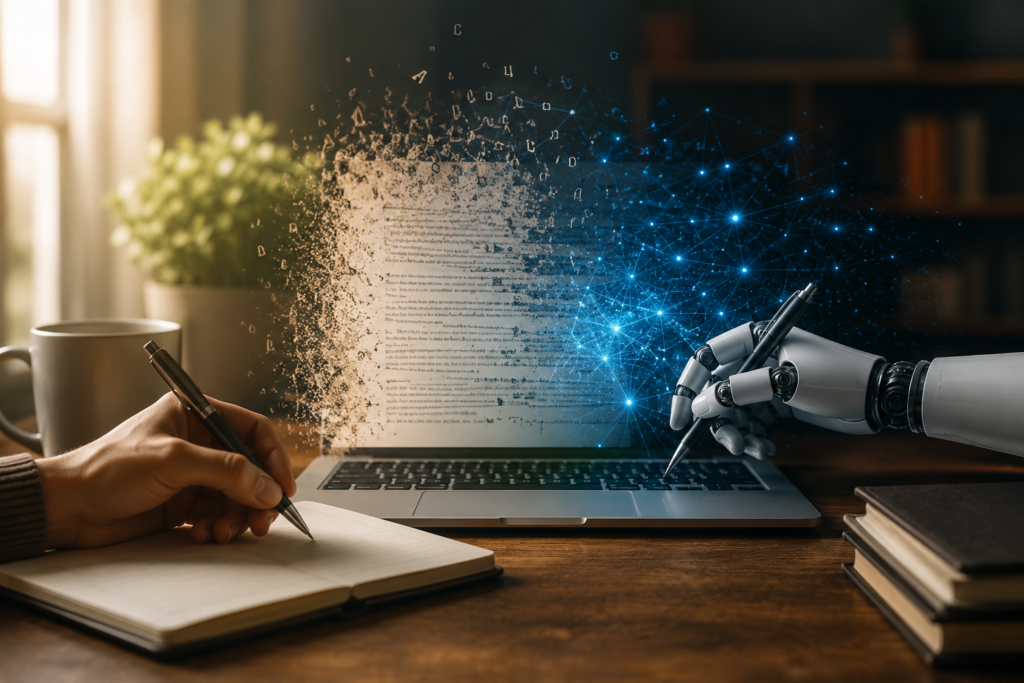
AI has changed the way we write.
A rough idea can become a polished paragraph in seconds. A long draft can be shortened, rewritten, or checked for grammar with a simple prompt. For writers, AI can be incredibly useful.
But there is a difference between improving writing and editing writing.
Editing isn’t simply about finding mistakes. It is about deciding what deserves to stay, what needs to change, and what the reader actually needs to take away from the piece.
And that is where human intelligence still matters.
AI can improve your writing. But can it improve your thinking?
AI is remarkably good at spotting patterns.
It can identify repetition, awkward sentences, grammatical errors, passive voice, unclear phrasing, and even suggest a more suitable tone. These are useful capabilities, especially when you’re staring at a draft you’ve already read ten times.
But good editing begins before the sentence level.
Ask yourself: Is this argument worth making? Is this example relevant? Does this sound like me? Have I explained the idea clearly enough for my reader? Am I saying something useful, or simply saying something that sounds useful?
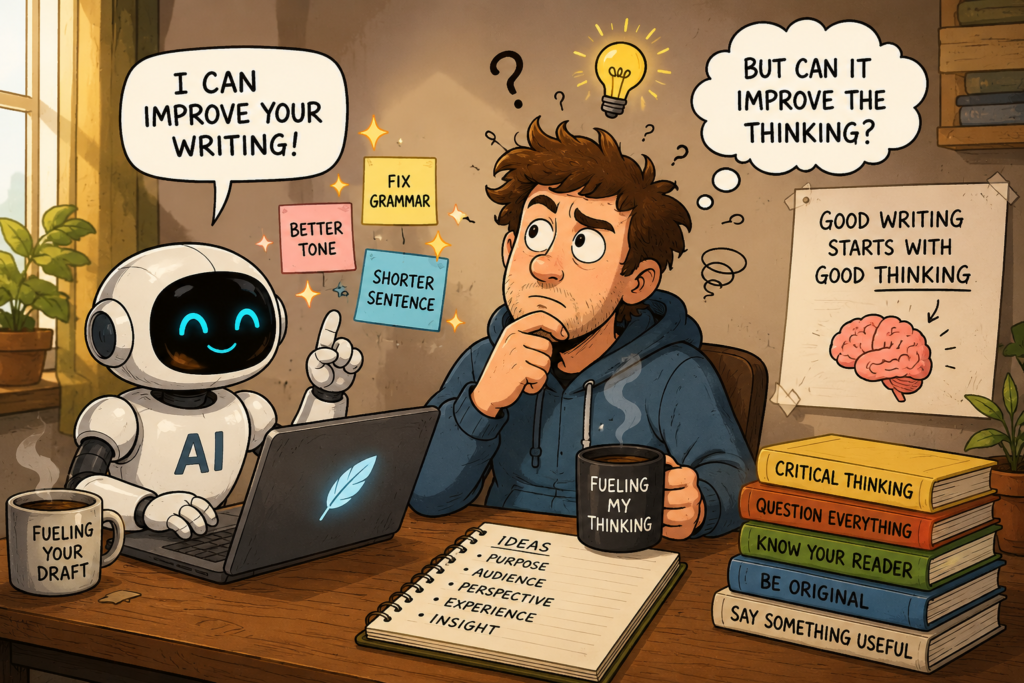
These aren’t just language problems. They are thinking problems.
AI can give you five alternative ways to express an idea. It is still the writer who has to decide whether the idea itself belongs in the piece.
That is the real difference between using AI to edit and actually editing in the age of AI.
Research supports the idea that AI can be valuable when humans remain involved. A 2025 systematic review and meta-analysis covering 28 studies and 8,214 participants found that people working with generative AI performed better on creative tasks than people working without AI. However, the same analysis also found a substantial reduction in the diversity of ideas produced through human-AI collaboration.
In other words, AI can improve the process without making human judgment unnecessary.
Editing is more than correcting errors
For a long time, editing was often associated with correction: spelling, grammar, punctuation, sentence structure and consistency.
Those things matter. But they are only one layer of editing.
A writer also needs to examine the structure of an argument, the rhythm of the piece, the strength of its examples, the emotional impact of its words and the relationship between the content and its intended audience.
Consider a simple sentence: “Technology is changing the workplace.”
There is nothing grammatically wrong with it. An AI tool may even approve it as clear and concise.
But is it interesting? Is it specific? Does it tell the reader anything they didn’t already know?
A human writer can recognize that the problem isn’t the sentence. The problem is the thinking behind the sentence.
Human editing asks harder questions.
- Why does this matter?
- What am I really trying to say?
- What evidence supports it?
- What would make the reader care?
Research comparing a human-written scientific manuscript with an AI-generated one illustrates this distinction. The AI-generated manuscript scored higher for clarity and readability (9.0 vs. 7.2), but lower for technical accuracy (6.3 vs. 9.3) and depth (5.5 vs. 7.5). Reviewers also noted that the AI version lacked depth, critical analysis, and contextual interpretation.
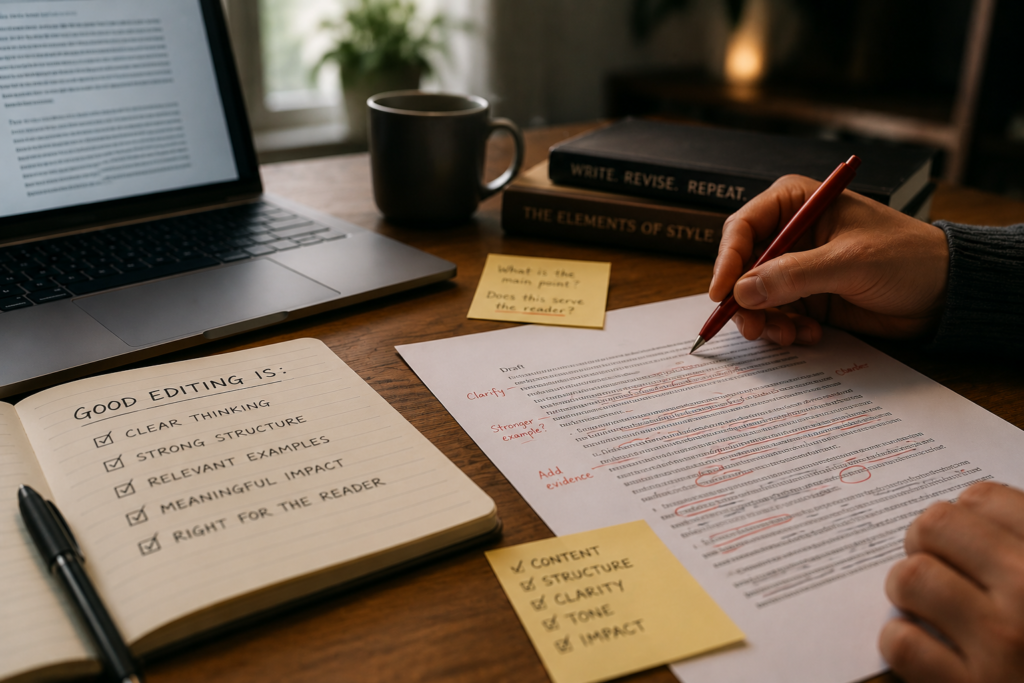
That layer of editorial judgment cannot be reduced to grammar correction.
Your voice still needs a human behind it
One of the biggest risks of relying too heavily on AI when editing is that your writing can become technically better while becoming less you.
AI tends to optimize language based on patterns. It can make a sentence smoother, more concise, and more conventionally readable.
But sometimes the slightly unusual sentence is the one that sounds like a real person.
Writers have a voice because they have experiences, preferences, opinions, cultural contexts, and ways of seeing the world. Those things don’t always follow the rules of polished writing.
An editor’s job isn’t necessarily to remove every imperfection.
Sometimes it is to protect the imperfection that gives the writing character.
Research into AI and creative writing offers another reason to protect that human element. Across three preregistered studies involving 2,200 college admissions essays, researchers found that each additional human-written essay contributed more new ideas than an additional GPT-4 essay. Human writing increased collective semantic diversity by approximately 2–8 times as much as GPT-4 writing.
This matters because good editing isn’t only about making existing ideas clearer. It is also about recognizing whether a piece has something genuinely its own to say.
This is why human editing remains important even when AI can identify what is technically wrong with a piece of content.
AI can suggest. You still have to judge.
The most useful way to think about AI and writing may be to treat AI as a second pair of eyes, not the final decision-maker.
Ask AI to point out repetition. Then decide whether the repetition is actually a problem.
Ask it to suggest a stronger introduction. Then decide whether the new introduction still sounds like you.
Ask it to challenge your argument. Then examine whether its criticism reveals a genuine weakness or simply a different perspective.
The important step is the one between suggestion and decision.
That step requires judgment.
And judgment comes from understanding your purpose, your reader, your subject, and your own point of view.
The writer becomes the editor
This is perhaps the biggest shift brought by AI.
When writers had fewer automated tools, editing naturally required more deliberate human attention. Today, it is easy to hand a draft to an AI tool and accept whatever comes back as an improvement.
But convenience can create complacency.
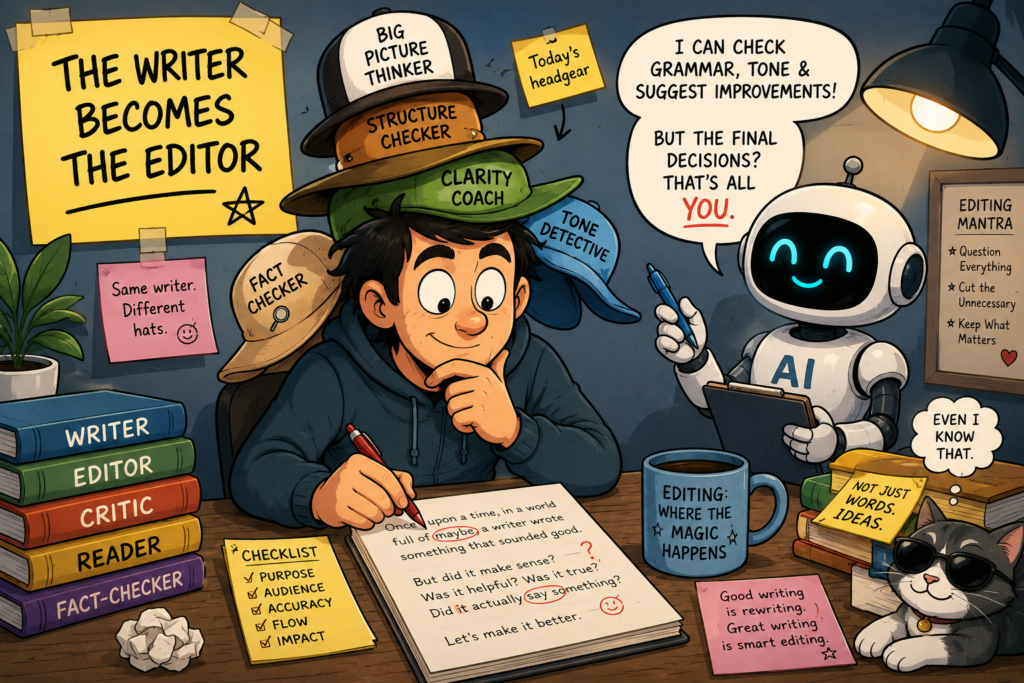
If AI rewrites every awkward sentence, you may never ask why the sentence was awkward. If it restructures your article, you may never examine whether the original structure reflected a better argument. If it makes your writing sound more polished, you may not notice that it has also made it more generic.
There is also a cognitive reason to remain involved. A 2025 study of 666 participants found a significant negative relationship between frequent use of AI tools and critical-thinking ability, with cognitive offloading mediating the relationship. The finding is correlational, so it does not prove that AI use causes weaker critical thinking, but it does raise an important question about what happens when we routinely hand cognitive work over to AI.
The answer isn’t to stop using AI.
It is to become a more conscious editor.
Read your draft without the AI suggestions open. Read it as a reader rather than its author. Look for unsupported claims, unnecessary ideas, weak transitions and places where the writing sounds impressive without actually saying much.
Then use AI where it genuinely helps.
Editing in the age of AI means knowing what not to automate
The future of writing isn’t necessarily human versus AI.
It is more likely to be human intelligence working with AI.
Let AI handle some of the repetitive work. Let it find errors you might have missed. Let it offer alternatives, challenge assumptions, and help you see your draft from another angle.
But keep the important decisions human.
- Decide what the piece is trying to say.
- Decide who it is for.
- Decide which ideas deserve space.
- Decide whether an argument is convincing.
- Decide whether a sentence sounds like you.
Most importantly, decide whether the final piece deserves your name on it.
AI can help you edit your words.
It cannot take responsibility for your thinking.
And perhaps that is what editing in the age of AI really demands from writers: not less human intelligence, but more.
Frequently asked questions on human editing in the age of AI (FAQs)
- Can AI replace human editing?
No. AI can identify grammar, spelling, repetition, and readability issues, but human editors provide context, judgment, creativity, and an understanding of the writer’s voice and audience.
- Why is human editing still important when AI can edit content?
Human editing evaluates the meaning and purpose of content, not just its language. Writers still need to decide whether an idea is accurate, relevant, original, persuasive, and appropriate for the intended audience.
- How should writers use AI when editing?
Writers can use AI to identify errors, suggest alternative phrasing, flag repetition, and challenge unclear ideas. The writer should review every suggestion and make the final editorial decisions.
- Can AI affect a writer’s voice?
Yes. Over-relying on AI rewrites can make content sound generic or overly polished. Writers should use AI selectively and preserve the phrases, perspectives, tone, and stylistic choices that make their writing distinctive.
- What is the best approach to editing in the age of AI?
Use AI as an editing assistant, not the final editor. Let AI handle repetitive checks while human intelligence remains responsible for ideas, structure, accuracy, voice, audience, and overall quality.
