
What’s in This Blog?
- Why content writers and AI tools are becoming inseparable in modern content workflows
- The real risks AI creates for writers, and why stagnation is a bigger threat than automation
- Ways how writers can use AI to work faster without losing originality or control
- The skills that will define the future of content writers in an AI-driven content ecosystem
- How writers can future-proof their careers by combining strategic thinking with AI efficiency
AI tools are no longer a distant trend for writers. They are already embedded into everyday content workflows, from brainstorming headlines to drafting full-length articles in minutes.
For many professionals, this has triggered an uncomfortable question: Where does that leave human writers?
The truth is, the conversation around content writers and AI tools is often framed the wrong way. This is not a battle between humans and machines. It represents a shift in how writing work is done and the kind of value writers are expected to deliver. While AI can generate words at scale, it still lacks intent, context, judgment, and originality.
Writers who understand how to evolve alongside AI will not just survive this change. They will thrive. The key lies in understanding where AI excels, where it falls short, and how content writers can reposition themselves as thinkers, strategists, and quality controllers, rather than merely being word producers.
Why AI Tools Are Reshaping the Content Writing Landscape
AI tools are reshaping content writing because businesses are under constant pressure to move faster, publish more, and reduce costs. Automation fits neatly into that equation. Tasks that once took hours can now be completed in minutes, making content writers and AI tools an unavoidable pairing in modern workflows.
Most AI systems excel at pattern-based writing. They can summarize existing information, rewrite common formats, and generate surface-level content quickly. This is especially attractive for businesses that produce high volumes of blog posts, product descriptions, landing pages, or social media posts. From a commercial standpoint, the appeal is obvious.
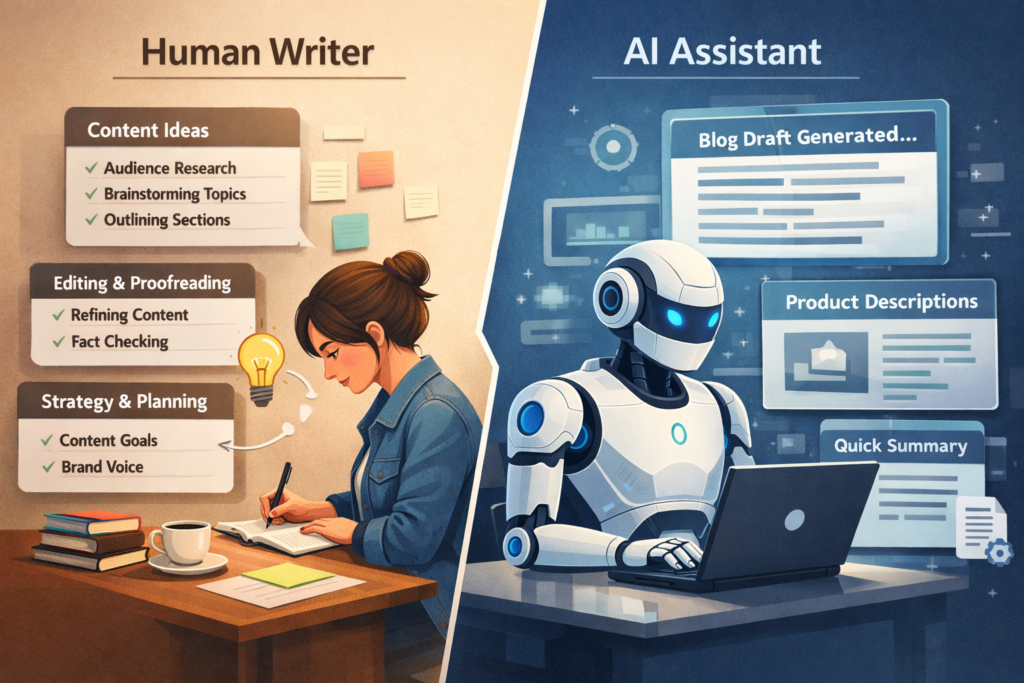
However, this shift does not mean quality writing has become less important. It means that basic writing has become cheaper and easier to replace. AI is absorbing the repetitive, predictable parts of content creation. As a result, the value of human writers is moving away from execution and toward decision-making.
Understanding this shift is critical. Writers who continue to rely only on manual drafting will struggle. Writers who learn how to integrate content writers and AI tools into smarter workflows will gain a significant advantage in speed, scale, and relevance.
The Real Risk for Content Writers Is Not AI…..It’s Stagnation!
The biggest threat to writers today is not artificial intelligence. It is standing still while expectations change. AI does not eliminate the need for writers; it exposes writers who have not evolved beyond basic content production.
Writers who simply follow briefs, rewrite existing content, or focus only on word count are the most vulnerable. These tasks are exactly where content writers and AI tools overlap. When the output looks generic and lacks original thinking, AI can replicate it with ease.
In contrast, writers who bring insight, structure, audience understanding, and strategic clarity remain difficult to replace. Businesses still need someone to decide what to say, why it matters, and how it should influence the reader. AI can assist with execution, but it cannot own accountability or intent.
Stagnation happens when writers resist learning new tools, ignore shifting expectations, or assume their current skills will always be enough. In an AI-driven environment, growth is no longer optional. Writers must actively expand their role or risk becoming interchangeable with the tools they fear.
How Writers Can Use AI as a Productivity Multiplier (Not a Replacement)
AI becomes powerful for writers only when it is treated as an assistant, not an author. The real opportunity lies in understanding how writers can use AI to remove friction from their workflow while retaining creative and strategic control.
Instead of replacing thinking, AI can reduce the time spent on mechanical tasks. This allows writers to focus on clarity, depth, and intent.
Practical ways for writers to use AI effectively:
- Generating topic ideas and headline variations
- Creating first-draft outlines for blogs and long-form content
- Summarizing research material or competitor content
- Rewriting sections for clarity or alternative tones
- Identifying gaps or redundancies in drafts
Where writers add value is in refining, restructuring, and contextualizing AI output. AI may give you speed, but judgment still belongs to humans. Writers who master how writers can use AI responsibly can deliver faster turnaround times without sacrificing quality, which makes them more valuable, not less.
New Skills Content Writers Must Develop in an AI-Driven Workflow
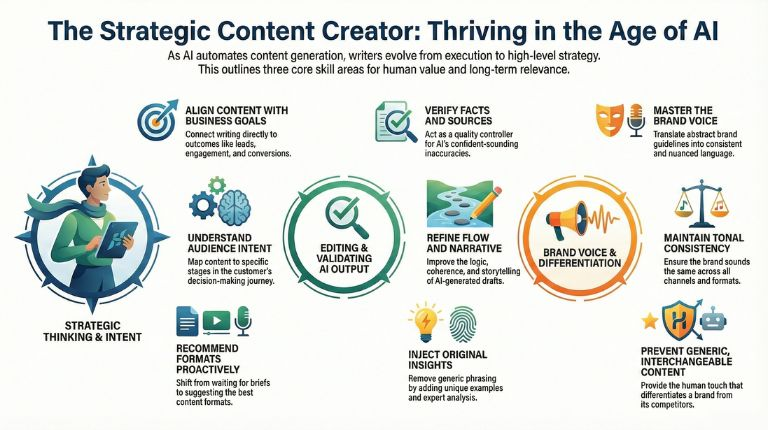
As AI takes over execution-heavy tasks, writers must move up the value chain. The future of content writers will be defined less by how well they write sentences and more by how well they think.
Strategic Thinking and Content Intent
Strong writers will increasingly be expected to:
- Understand audience intent and decision stages
- Align content with business goals like leads, engagement, or conversions
- Recommend content formats instead of waiting for briefs
This shift places writers closer to strategy than production, which is where long-term relevance lies.
Editing, Refinement, and Fact-Checking AI Output
AI-generated content often sounds confident even when it is inaccurate or shallow. Writers must act as editors and validators.
Key responsibilities include:
- Verifying facts and sources
- Improving flow, logic, and narrative coherence
- Removing generic phrasing and repetition
- Injecting original insight and examples
In this model, writers become quality controllers, not just creators.
Brand Voice, Tone, and Differentiation
AI struggles to maintain a consistent brand voice. This is a major opportunity for writers.
Writers who understand brand nuance can:
- Translate abstract brand guidelines into consistent language
- Maintain tone across formats and channels
- Prevent content from sounding generic or interchangeable
These skills will be central to the future of content writers, especially in competitive industries.
AI Tools for Content Writing Every Writer Should Understand
You do not need to master every tool, but you must understand the ecosystem. Familiarity with AI tools for content writing is quickly becoming a baseline expectation.
Instead of naming tools, it is more useful to understand categories.
Core categories of AI tools for content writing:
- Ideation and topic research tools
- Drafting and rewriting assistants
- SEO and content optimization platforms
- Grammar, readability, and editing tools
- Content analysis and performance tools
What matters is not tool loyalty, but tool literacy. Writers who understand where AI tools for content writing fit into the process can adapt quickly as platforms evolve. Over-dependence is risky, but informed usage is a competitive advantage.
What Clients and Employers Will Expect From Writers Going Forward
Expectations from writers are already changing, even if job titles have not caught up. Businesses working with content writers and AI tools now expect more than clean prose.
Common expectations going forward include:
- Faster turnaround times with consistent quality
- Ability to collaborate with AI-assisted workflows
- Understanding of SEO, audience intent, and content performance
- Clear reasoning behind content decisions
Clients and employers are not paying for words anymore. They are paying for outcomes. Writers who understand this shift and adapt accordingly will be aligned with the future of content writers, not competing against it.
How Content Writers Can Future-Proof Their Careers
Future-proofing is less about learning one specific tool and more about expanding your professional identity. Writers who survive long-term will be those who integrate thinking, strategy, and execution.
Ways content writers can future-proof themselves:
- Specialize in niches instead of staying generic
- Learn adjacent skills like SEO, CRO, and content strategy
- Position themselves as advisors, not task-takers
- Stay curious about how writers can use AI without outsourcing judgment
AI will continue to evolve. Writers who evolve alongside it, instead of reacting defensively, will remain relevant and in demand.
AI Won’t Replace Content Writers….But It Will Redefine Them!
AI has not ended content writing. It has raised the bar. The rise of content writers and AI tools marks a transition from execution-focused roles to thinking-driven ones.
Writers who cling to old workflows will feel replaced. Writers who adapt will find themselves doing more meaningful work with greater impact. The real evolution is not technical; it is professional. It requires writers to rethink their value, sharpen their judgment, and embrace tools without surrendering ownership.
The future of content writers belongs to those who can combine human insight with AI efficiency.
Not faster typists…….but better thinkers.
What People Frequently Ask
1. Will AI replace content writers completely?
No. AI can automate repetitive writing tasks, but it cannot replace strategic thinking, audience understanding, brand voice, or original insight. The role of content writers and AI tools is shifting toward collaboration, not replacement.
2. How can writers use AI without losing originality?
Writers should utilize AI for ideation, outlines, and initial drafts, then apply their own judgment for structure, tone, and perspective. Knowing how writers can utilize AI as an assistant rather than an author helps preserve originality.
3. Are AI tools for content writing safe for SEO?
Yes, when used correctly. AI tools for content writing are effective if the final output is edited, fact-checked, and aligned with search intent. Search engines reward quality and usefulness, not the method of creation.
4. What skills will define the future of content writers?
The future of content writers will be driven by strategy, editing, intent mapping, brand consistency, and performance awareness, rather than pure writing speed.
5. Should beginner writers learn AI tools early?
Absolutely. Early familiarity with content writers and AI tools helps beginners build faster workflows, allowing them to focus their learning on thinking, structure, and clarity rather than relying solely on manual drafting.
