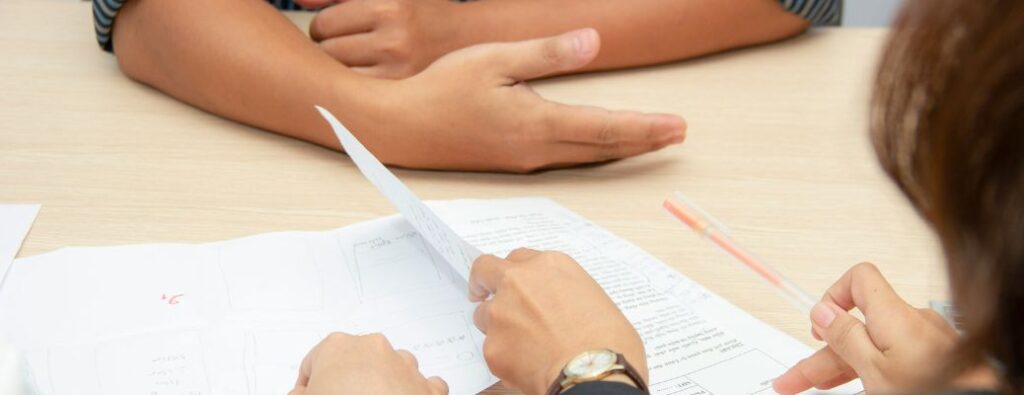
Interviews can be nerve-wracking.
Even if you have prepared well, there is something about sitting across from an interviewer and knowing that your answers, communication skills, and experience are being evaluated that can make you nervous.
You may know exactly what you want to say, but when the interview begins, you suddenly find yourself speaking too quickly, second-guessing your answers, or wondering whether you’re making a good impression.
So, how can you be confident in an interview when you’re nervous?
The good news is that confidence doesn’t mean you have to walk into an interview feeling completely fearless. You can be nervous and still come across as confident, prepared, and capable.
In fact, some of the best interview confidence tips are surprisingly simple.
Here are six practical ways to boost your confidence during an interview and handle those nervous moments a little better.
6 Straightforward Tips to Be Confident in Your Interview
Dress for Success
It might sound superficial, but what you wear can influence how you feel.
When you dress appropriately for an interview, you are not only creating a good first impression; you are also giving yourself a small psychological boost.
Think about how you feel when you put on an outfit that makes you feel comfortable and put together. You tend to carry yourself differently. You may stand a little straighter, feel more prepared, and become less conscious of how you look.
That can be particularly helpful when you’re already dealing with interview nervousness.
Of course, dressing appropriately doesn’t mean wearing something extremely formal for every interview. The right choice depends on the company, industry, and role.
A corporate interview may call for formal business attire, while a creative workplace may have a much more relaxed dress code.
If you’re unsure, research the company’s culture beforehand or choose something slightly more professional rather than being too casual.
The idea is simple: wear something that makes you feel comfortable, professional, and ready to have a conversation.
When you aren’t worrying about whether your clothes are appropriate, you have more mental space to focus on the interview itself.
And that can make it easier to feel confident before an interview.
Practice Positive Body Language
You don’t always need to say that you’re confident.
Sometimes, your body language says it for you.
Your posture, eye contact, facial expressions, and gestures can influence how confident and comfortable you appear during an interview.
Try to sit upright without becoming stiff. Keep your shoulders relaxed. Maintain natural eye contact when speaking and listening. Avoid constantly looking down or fidgeting with your hands.
But don’t overthink it.
You don’t need to sit like a statue or maintain intense eye contact throughout the entire interview. That can actually make you more self-conscious.
Instead, think about having a normal conversation with another person.
Listen when the interviewer speaks. Nod when appropriate. Smile naturally. Let your expressions respond to what is being said.
These small things can help you look confident in an interview, even if you are feeling nervous internally.
The same applies to a virtual interview. Keep your camera around eye level, make sure your face is clearly visible, and try to look toward the camera when you’re speaking.
Remember, confident body language isn’t about pretending to be someone you’re not.
It’s about looking comfortable enough to be present in the conversation.
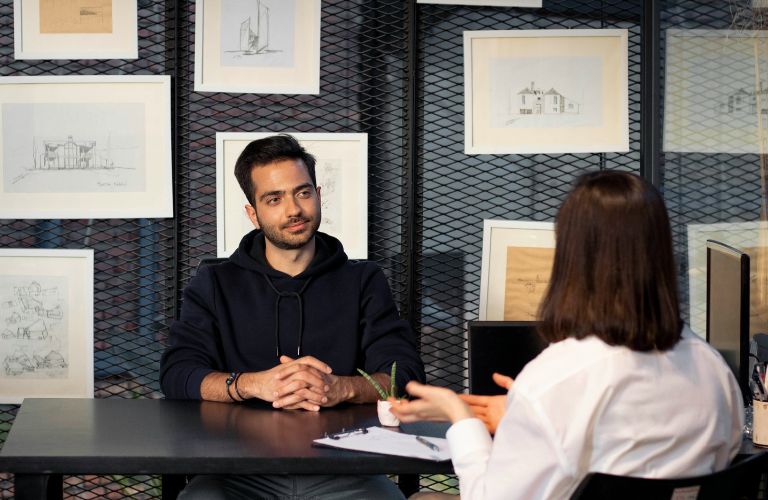
Use the Power of Visualization (an additional pre-interview tip)
Before an interview, it’s very easy to imagine everything that could go wrong.
- What if I don’t know the answer?
- What if I freeze?
- What if they don’t like me?
- What if I say something stupid?
The problem with constantly imagining these scenarios is that your brain starts treating them as possibilities you need to prepare for rather than simply thoughts.
Instead, try visualizing the interview going well.
Take a few minutes before the interview and imagine yourself walking into the room or joining the video call calmly.
- Imagine yourself greeting the interviewer confidently.
- Imagine yourself listening carefully to the questions.
- Imagine yourself taking your time before answering.
- Imagine yourself handling a difficult question without panicking.
This doesn’t mean convincing yourself that you’re definitely going to get the job. It simply gives your mind a more constructive scenario to focus on.
Visualization can be particularly useful when you’re trying to figure out how to overcome nervousness in an interview. You’re essentially giving yourself a mental rehearsal before the real conversation begins.
And remember, success doesn’t have to mean getting the job.
A successful interview could simply mean that you communicated your experience clearly, answered honestly and learned something from the conversation.
That is something you can control.
Control Your Breathing
This is probably one of the simplest pieces of advice you’ll hear about how to stay calm during an interview.
And yes, it sounds obvious.
But when you’re nervous, you can forget to breathe properly.
Your breathing becomes faster and shallower, your heart starts racing, and your body becomes even more alert. Taking a few slow, deliberate breaths before an interview can help you settle down.
You don’t need to perform an elaborate breathing exercise. Simply inhale slowly, pause for a moment, and exhale slowly.
Do this a few times before entering the interview or joining the video call.
You can also use your breathing as a reset button during the interview.
If you get a difficult question and feel yourself becoming overwhelmed, take a brief pause and breathe before answering.
You could even say: “That’s a good question. Let me think about that for a moment.“
There’s nothing wrong with taking a few seconds to gather your thoughts.
In fact, pausing can help you speak more confidently in an interview because you’re giving yourself time to organise what you want to say rather than rushing into an answer.
Talk About Your Strengths and Highlight Them
An interview is, in many ways, an opportunity to explain what you can bring to the role.
That doesn’t mean you have to boast about yourself. But if you don’t know your own strengths, it becomes difficult to communicate them confidently to someone else.
Before your interview, think about the skills you’re genuinely good at.
- Are you a good communicator?
- Are you good at solving problems?
- Are you organised?
- Do you work well under pressure?
- Are you good at working with people?
- Have you successfully completed projects or overcome difficult situations?
Don’t just list these qualities.
Think about examples that prove them.
For instance, saying:
“I’m a good problem solver.” isn’t nearly as convincing as saying: “In my previous role, we had a problem with X. I identified the issue, tried Y, and eventually managed to achieve Z.“
Specific examples give your answers credibility.
They also give you confidence.
When you know that you have real experiences to support the things you’re saying, you don’t have to rely on empty statements like, “I think I’m good enough for this job.”
You have evidence.
This is one of the most important parts of learning how to be confident in an interview: confidence becomes easier when you know what you have actually accomplished.
So before your next interview, spend some time thinking about your strengths, achievements and experiences.
Know what you bring to the table.
[Extra read: The Importance and Need of Strong Negotiation Skills in Business]
Try Staying Positive
This might be the most difficult one.
When you’re nervous, your mind can become your biggest critic.
You may start thinking:
- “I’m not experienced enough.”
- “There are probably better candidates.”
- “What if I mess this up?”
- “I’m terrible at interviews.”
These thoughts aren’t necessarily facts.
They’re often just the result of anxiety and uncertainty.
Instead of trying to convince yourself that everything will definitely go perfectly, try adopting a more realistic and positive mindset.
Tell yourself:
- “I’ve prepared for this.”
- “I don’t need to be perfect.”
- “It’s okay to take a moment before answering.”
- “I know my own experience.”
- “I can handle being nervous.”
Notice that none of these statements promise a particular outcome.
That’s intentional.
You don’t need fake positivity to be confident. You need to remind yourself that you are capable of handling the situation, whatever the outcome may be.
And if the interview doesn’t go perfectly, that doesn’t automatically mean you failed.
Perhaps you answered most questions well but struggled with one. Perhaps you were too nervous at the beginning but became more comfortable later.
Perhaps you didn’t get the job.
All of those experiences can teach you something. Every interview can make the next one easier because you’re learning how to communicate under pressure.
So if you’re wondering how to be confident in an interview, remember that confidence isn’t about eliminating every nervous thought.
It’s about not allowing those thoughts to control the entire conversation.

What If You’re Still Nervous?
Even after preparing, practising, and trying all these techniques, you may still feel nervous.
That’s completely normal.
You don’t have to eliminate nervousness to perform well in an interview. Your hands might be sweaty. Your heart might beat faster. You might need a few seconds to think about an answer.
None of those things automatically mean you’re doing badly.
If you find yourself getting extremely nervous during an interview, bring your attention back to what is happening in front of you.
Listen to the question.
Take a breath.
Pause.
Think.
Then answer.
Don’t spend the next few minutes worrying about whether your previous answer was good enough. The interviewer has probably already moved on.
And if you genuinely don’t understand a question, ask for clarification.
You can say: “Could you please elaborate on what you mean?“
That’s much better than rushing into an answer you don’t understand. The goal isn’t to appear completely fearless. The goal is to stay present and communicate even when you’re nervous.
Sometimes, that is what real confidence looks like.
Stay Positive Regardless of the Outcome of Your Interview. Learn From Your Experience.
Not every interview will lead to a job offer, and that’s okay. Confidence is more about resilience. Treat every interview as a learning experience and an opportunity for growth. Regardless of the outcome, remain positive and take lessons from each interview to improve your performance in the next one.
By implementing these confidence-boosting strategies, you can approach your interviews with greater self-assurance and professionalism. Remember, confidence is about believing in your abilities and presenting yourself as the best candidate for the job. With the right mindset and preparation, you can make a strong and lasting impression in any interview process.
Being confident in an interview doesn’t mean that you won’t feel nervous. It doesn’t mean you’ll have the perfect answer to every question. And it certainly doesn’t mean that you have to pretend to be someone you’re not.
Confidence comes from preparation, self-awareness and trusting yourself enough to have the conversation.
- Dress appropriately.
- Pay attention to your body language.
- Visualize success.
- Take a few deep breaths.
- Know your strengths.
- And try to maintain a positive mindset.
Most importantly, remember that being nervous doesn’t mean you’re not capable.
Sometimes confidence isn’t the absence of nerves.
Sometimes confidence is simply walking into the interview with those nerves and doing it anyway.
[Also read: Easy and Practical Ways to Make Employees Feel Valued]
Frequently Asked Questions About Interview Confidence
How can I be confident in an interview?
Preparation is one of the best ways to build interview confidence. Research the company, understand the job description, practise common questions and think about examples from your experience. During the interview, focus on listening, speaking clearly and taking your time before answering.
How can I stop being nervous during an interview?
You may not be able to eliminate interview nervousness, and you don’t need to. Take a few slow breaths, relax your shoulders, focus on the question being asked, and remind yourself that you don’t need to give a perfect answer. Good preparation can also reduce much of the uncertainty that causes nervousness.
How can I prepare for an interview to feel more confident?
Start with the job description and identify the skills and qualities the employer is looking for. Research the company, review common interview questions and prepare examples from your own experience. The more familiar you are with the role and your own background, the less likely you are to feel caught off guard.
What should I research about a company before an interview?
At a minimum, understand what the company does, its products or services, its customers, the role you’re applying for and why you would like to work there. Checking recent company news or developments can also help you ask more relevant questions during the interview.
Should I memorise my answers before an interview?
It’s better to understand the key points you want to communicate than to memorise complete answers word for word. Memorising can make you more anxious if the interviewer phrases a question differently. Practise speaking naturally about your experience instead.
How do I speak confidently in an interview?
Avoid rushing your answers. Listen carefully, pause briefly to organise your thoughts and then speak clearly. Practising your answers aloud before the interview can also help you become more comfortable talking about your experience.
What should I do if I speak too quickly when I’m nervous?
Become conscious of your pace and deliberately slow down. Take a short pause between the question and your answer, and allow yourself to breathe while speaking. You don’t have to speak unusually slowly; simply give yourself enough time to communicate your thoughts clearly.
Is it okay to pause before answering an interview question?
Absolutely. A short pause before answering can actually make you appear more thoughtful and composed. If you need more time, you can simply say, “That’s an interesting question. Let me think about that for a moment.”
What should I do if my mind goes blank during an interview?
Don’t panic. Take a breath and give yourself a few seconds to collect your thoughts. You can acknowledge the pause by saying, “That’s a good question. Let me think about that for a moment.” If you’re unsure what the interviewer means, you can also ask them to clarify the question.
What should I do if I don’t know the answer to an interview question?
Don’t immediately assume you’ve failed. If you don’t know the answer, be honest and, where possible, explain how you would approach finding or solving the problem. Showing your thought process can sometimes be more useful than pretending to know something you don’t.
How can I look confident even when I’m nervous?
Pay attention to natural body language. Sit comfortably upright, maintain reasonable eye contact, keep your shoulders relaxed and show that you’re listening. You don’t need to hide every sign of nervousness to appear confident.
What body language makes you look confident in an interview?
Good interview body language generally involves an upright but relaxed posture, natural eye contact, attentive facial expressions and controlled gestures. The goal isn’t to look rigid or overly rehearsed. You want to appear comfortable, engaged and interested in the conversation.
How can I stay calm during an interview?
Bring your attention back to the conversation whenever you notice yourself becoming anxious. Listen carefully to the question, take a breath, pause and then answer. Avoid thinking about how you’re being judged or worrying about your previous answer while the interview is still happening.
What can I do if I’m extremely nervous during an interview?
First, remind yourself that nervousness doesn’t automatically mean you’re performing badly. Take a slow breath, relax your shoulders and focus on the question in front of you. If you need a moment to think, take it. Your goal isn’t to eliminate every nervous feeling but to continue communicating despite them.
Can breathing exercises help with interview anxiety?
Taking a few slow, deliberate breaths before an interview can help you feel more settled and give you a moment to reset when you’re nervous. You can also take a natural breath before answering a difficult question during the interview.
Should I tell the interviewer that I’m nervous?
You don’t have to announce that you’re nervous. If you need a moment to collect your thoughts, simply pause or say that you’d like a moment to think. Being nervous is normal, and you don’t need to draw attention to it unless you feel there is a genuine reason to do so.
How can I be confident in an interview if I don’t have much experience?
Focus on the experience you do have. College projects, internships, freelance work, volunteering, personal projects and other responsibilities can demonstrate useful skills. Think about situations where you solved problems, worked with others, took initiative or achieved something, and explain what you learned from those experiences.
How can I talk about my strengths without sounding arrogant?
Focus on evidence rather than exaggerated claims. Instead of simply saying, “I’m an excellent communicator,” explain a situation where your communication skills helped you solve a problem or achieve a result. Specific examples allow you to communicate your strengths without sounding like you’re boasting.
How can I be confident in a virtual interview?
Prepare your technology beforehand, check your camera and microphone, choose a quiet space and position your camera around eye level. Keep a few simple notes nearby if helpful, but avoid reading from a script. During the interview, look toward the camera when speaking and give the conversation your full attention.
How do I prepare for a video interview?
Test your internet connection, camera, microphone and interview software before the scheduled time. Choose a quiet and reasonably well-lit space, remove distractions and keep your resume or a few brief notes nearby. Joining the meeting a few minutes early can also prevent unnecessary last-minute stress.
How can I feel confident before an interview?
Prepare as much as you reasonably can. Know the role, research the company, practise talking about your experience and decide what you want to wear and take with you beforehand. Just before the interview, take a few slow breaths and remind yourself that you don’t need to be perfect.
What if I give a bad answer during an interview?
Don’t let one answer determine how you approach the rest of the interview. If you realise you’ve misunderstood a question, correct yourself. If you could have explained something better, move on and focus on the next question. An interview is a conversation made up of many answers, not one single moment.
How can I become more confident after a bad interview?
Reflect on the interview without being overly critical of yourself. Write down the questions you struggled with, moments where you became nervous and things you think went well. Use those observations to prepare differently for your next interview. Confidence often grows through repeated experience rather than appearing all at once.