An interview can feel a lot less scary when you know what you’re walking into.
You don’t need to predict every question the interviewer will ask. You don’t need to memorize perfect answers. And you definitely don’t need to spend three nights Googling “best answer for every possible interview question.”
Good interview preparation is much simpler than that.
The idea is to walk into the room thinking, “I know what I’m talking about, and I’m ready to have a conversation.”
Here’s how to get there.
Understand the Job You’re Actually Interviewing For
Start with the job description.
It sounds obvious, but many candidates read it once, apply, and forget about it.
Go through it again and look for three things:
- What will you actually be doing?
- What skills are they looking for?
- What problems might you be expected to solve?
For example, if you’re applying for a content writer role and the description repeatedly mentions SEO, research, and long-form writing, think of specific examples from your experience that demonstrate those skills.
Now, when they ask, “Tell us about your experience,” you have something relevant to talk about.
You’re not just saying you’re good at writing. You’re showing them why you’re a good fit for this particular role.
Research the Company, But Don’t Go Overboard
You don’t need to know the company’s history since 1987.
You do need to know what they do, who their customers are, and what the company seems to care about.
Spend some time on their website and LinkedIn page. Look at their products, recent announcements, and the language they use to describe themselves.
Then ask yourself: “Why would I actually want to work here?”
Have a genuine answer ready.
It could be something as simple as: “I like that your company works with small businesses. I’ve spent a lot of my career creating content for that audience, so the role feels like a natural fit.”
That’s much stronger than: “Your company has a very good reputation.”
Prepare Your Own Stories
Here’s a simple interview preparation trick: don’t just prepare answers. Prepare stories.
Think of three to five situations from your career, education, or previous experience where you:
- Solved a problem
- Made a mistake and learned from it
- Worked with a difficult person
- Took initiative
- Achieved something you’re proud of
- Handled a challenging situation
You can use these stories to answer multiple interview questions.
For example, one story about successfully handling a difficult client could work for questions about communication, conflict, problem-solving, and pressure.
You don’t need ten different stories. You need a few good ones that you know well.
Practice Out Loud
This is where job interview preparation often goes wrong.
People read questions and think, “Yeah, I know what I’d say.”
Then the actual question comes, and their brain suddenly says:
Nope. Never heard of those words before.
Practice speaking your answers out loud. Even better, ask a friend to conduct a mock interview.
Don’t try to sound perfect. Pay attention to whether you’re speaking too quickly, giving extremely long answers, or using “um” every five seconds.
The first few attempts might feel awkward.
That’s okay. You’re practising precisely so the real interview feels less unfamiliar.
Prepare for the Obvious Questions
You don’t need to memorize answers, but you should have a rough idea of what you’ll say when you’re asked common questions such as:
- Tell me about yourself.
- Why do you want this job?
- Why should we hire you?
- What are your strengths?
- What is one area you’re working to improve?
- Tell me about a challenge you faced.
- Where do you see yourself in a few years?
Think about the key points you want to communicate. That way, you can answer naturally instead of trying to remember a paragraph.
And if you want to prepare specifically for behavioral questions, learning the STAR method can make your answers much easier to structure. More importantly, preparation removes interview anxiety from the equation.
Prepare Questions for Them
An interview isn’t just the company deciding whether you’re good enough.
You’re also deciding whether you want to work there.
So when the interviewer asks: “Do you have any questions for us?”
Don’t say, “No, I think you’ve covered everything.”
Prepare two or three genuine questions.
For example:
- What would success look like in the first six months?
- What does a typical day in this role look like?
- What is the biggest challenge someone in this position would face?
- How does the team usually work together?
Good questions show that you’re thinking beyond simply getting the job.
Sort Out the Practical Stuff
This part isn’t exciting, but it can save you from unnecessary stress.
The day before your interview, check these.
In person: Location, travel time, parking, clothes and documents.
Online: Internet connection, camera, microphone, background and meeting link.
And don’t underestimate the value of arriving early.
Being five minutes early gives you time to breathe.
Being five minutes late gives you a completely different problem to solve.
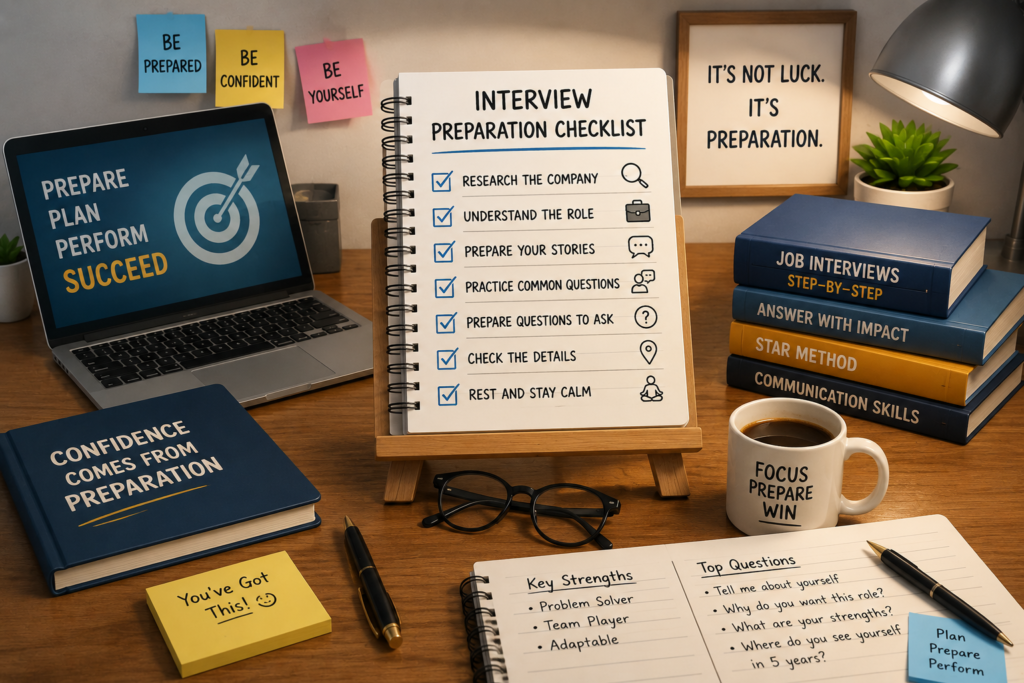
Your Printable Interview Preparation Checklist
Before you close your laptop and head to bed, run through this list.
2–3 Days Before
☐ Read the job description carefully
☐ Identify the key skills the employer wants
☐ Research the company and its work
☐ Understand what the role involves
☐ Prepare 3–5 stories from your experience
☐ Think through common interview questions
☐ Prepare 2–3 questions to ask the interviewer
☐ Choose your interview outfit
The Day Before
☐ Practice answering questions out loud
☐ Do a mock interview if possible
☐ Review your key stories and achievements
☐ Check the interview location or meeting link
☐ Prepare your documents/resume
☐ Test your camera, microphone, and internet if it’s online
☐ Set an alarm and plan your travel
☐ Get a good night’s sleep
30 Minutes Before
☐ Check that everything you need is ready
☐ Drink some water
☐ Take a few slow breaths
☐ Review your key points; don’t cram
☐ Put your phone on silent
☐ Relax your shoulders and sit upright
☐ Remind yourself: “I don’t need to be perfect. I just need to be present.”
Don’t Try to Become a Different Person
This might be the most important part of interview preparation.
You aren’t preparing to become some ultra-confident version of yourself who has a perfect answer for everything.
You’re preparing to communicate what you already know.
You will probably stumble over a sentence. You might need a few seconds to think. You might even answer and realize later that you could have said it better.
That’s normal. The goal isn’t perfection.
It’s being prepared enough that when nerves show up, they don’t completely take over.
And that’s where preparation connects directly to confidence.
When you’ve researched the company, understood the role, practised your stories and thought through your answers, you have something solid to fall back on.
You walk into the interview not thinking, “I hope I can do this.”
You walk in thinking: “I’m ready. Let’s have the conversation.”
Frequently Asked Questions
How early should I start preparing for an interview?
Ideally, start preparing 2–3 days before the interview. This gives you enough time to research the company, understand the role, prepare examples and practise your answers without cramming everything into the night before.
What should I research before a job interview?
At a minimum, understand what the company does, who its customers are, what the role involves and what skills the employer is looking for. You can also look at recent company news or updates, so you have a better idea of what is happening in the organization.
How can I practise for an interview?
Practise answering common interview questions out loud, rather than just reading them silently. A mock interview with a friend can be even more useful because it helps you get comfortable thinking and responding in real time.
Should I memorize my interview answers?
No. It’s better to remember key points and examples than memorize complete answers. Memorized answers can sound rehearsed and can throw you off if the interviewer phrases a question differently.
What should I do immediately before an interview?
Avoid last-minute cramming. Give yourself a few minutes to breathe, review your key points, check that you have everything you need, and remind yourself that you don’t need to give perfect answers; you simply need to have a good conversation.