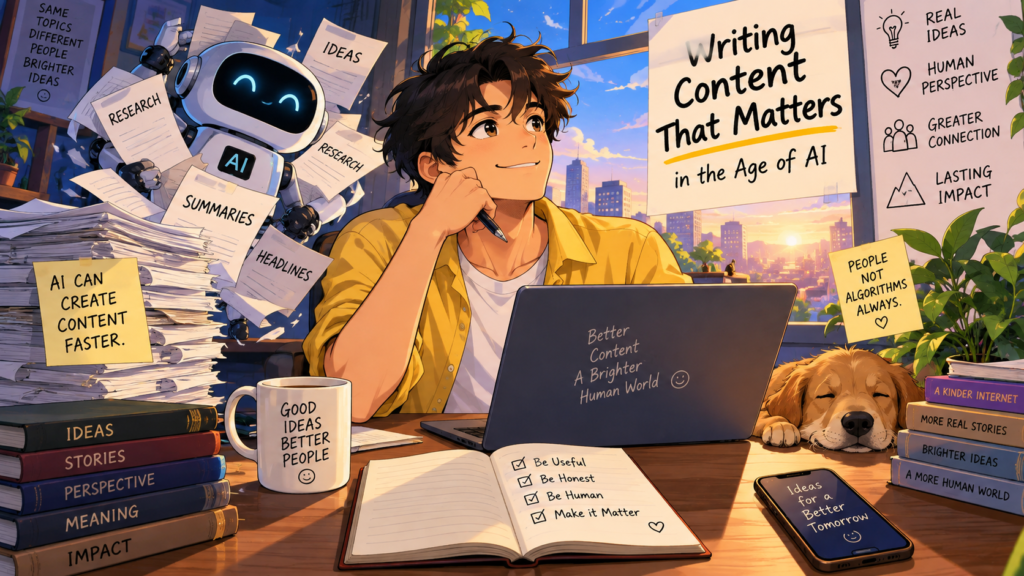
AI can write an article in seconds.
It can generate headlines, suggest outlines, summarize research, and turn a handful of ideas into thousands of words.
So, when everyone can create content faster, what makes content worth reading?
The answer isn’t more information. It is connection.
In the age of AI, writing content that matters means creating something that makes a reader stop, think, learn, feel understood, or see a familiar problem differently.
Because the internet has never had a shortage of words. What it needs is more content worth remembering.
What does it mean to write content that matters?
Meaningful content starts with a simple idea: the reader should get something from it.
That something could be an answer, an insight, a solution, a new perspective, a useful idea or even the feeling that someone finally understands what they are dealing with.
This changes the question a writer asks.
Instead of asking, “What should I write about?”, ask: “What does my reader need from me?”
That distinction matters.
A 1,000-word article can contain plenty of information and still leave the reader with nothing. Another 500-word article can change the way someone approaches a problem.
Good content isn’t measured only by how much it contains.
It is measured by what it does for the person reading it.
Why does meaningful content matter in the age of AI?
AI has made producing average content remarkably easy.
Give it a topic and a few instructions, and you can have an article in minutes. Do it again with a slightly different prompt and you can have another one.
This creates an interesting problem.
When everyone can publish, publishing itself becomes less valuable.
Readers have more choices. Search results have more competing articles. Brands have more content competing for attention.
So what makes one piece stand out?
Often, it is the things that are difficult to manufacture at scale: experience, perspective, originality, context, and empathy.
Anyone can write that consistency is important for content marketing.
A writer who has actually built a content system can explain what consistency looks like when there isn’t enough time, when ideas run out, or when a team has five different opinions about what to publish.
That is the difference between information and insight.
How do you write content that connects with readers?
Start with the person, not the keyword.
Before you write, understand what your audience is trying to accomplish. What are they struggling with? What have they probably already read? What might they misunderstand? What would make their job easier?
Then bring something of your own to the conversation.
It could be an experience, an observation, a useful example, or an unexpected way of looking at the subject.
Specificity creates connection.
Compare:
“Businesses should understand their customers.”
with:
“If your customer has to read your homepage twice to figure out what you actually do, the problem may not be your customer. It may be your messaging.”
The second statement gives the reader something to recognize.
That is what good content does. It doesn’t merely tell people something. It helps them see something.
What makes content feel human?
Human-centered content isn’t about throwing casual language into every paragraph or adding jokes to make an article sound less robotic.
It is about bringing human qualities into the thinking behind the content.
That means having:
- A genuine point of view
- Relevant experiences
- Specific examples
- Curiosity
- Empathy
- Nuance
- Stories where they add value
- Language that sounds natural rather than manufactured
Most importantly, human content has a reason behind it.
It knows who it is talking to and why.
This is where AI-assisted content can easily go wrong. A piece can be grammatically flawless, well-structured, and factually reasonable while still feeling strangely empty.
The problem isn’t necessarily the sentences.
There may simply be no real thought behind them.
Can AI help you create meaningful content?
Absolutely.
AI can be a powerful writing partner. It can help brainstorm ideas, organize research, identify gaps, generate alternative headlines, simplify complex explanations, and repurpose existing material.
The mistake is assuming that because AI can produce the words, it should produce the thinking too.
Use AI to accelerate the process. Don’t outsource your judgment to it.
A writer still needs to ask:
- Is this actually useful?
- Is it accurate?
- Is there anything original here?
- Does this reflect what my audience cares about?
- Does it say something worth saying?
- What should I add from my own experience or perspective?
AI can help you get from idea to draft faster.
It cannot decide whether the idea deserves to become content.
How can you make your content more engaging?
Make every section earn its place.
Replace generic advice with examples. Replace complicated explanations with clarity. Replace repetition with insight.
And don’t be afraid to have a point of view.
Content that tries to be universally agreeable often becomes forgettable.
You don’t need to manufacture controversy. You simply need to say something you actually believe, explain why you believe it, and give the reader enough substance to make up their own mind.
The goal isn’t to make every reader agree with you.
The goal is to make the reader think, “That’s useful. I hadn’t looked at it that way.”
Original thinking is the real content advantage
AI can produce endless variations of existing ideas.
That makes original thinking more valuable, not less.
Originality doesn’t mean discovering something nobody has ever said. It can mean connecting familiar ideas in an unfamiliar way. It can mean drawing on an experience that others haven’t had. It can mean explaining a common problem more clearly than everyone else.
Your perspective is part of the value you bring to your content.
Protect it.
Use AI for the heavy lifting where it helps, but don’t let it sand away the edges that make your thinking recognizably yours.
The future belongs to content people care about
AI will make content creation faster. There is no going backwards from that.
But speed isn’t the same as value.
As producing content becomes easier, writing content that matters will become more important.
The competitive advantage won’t necessarily belong to the person who publishes the most.
It may belong to the person who understands their audience deeply, has something useful to say, and knows how to say it in a way people remember.
Because when everyone can generate words, the real skill is knowing which words are worth writing.
Frequently asked questions (FAQs)
What is content that connects with readers?
Content that connects with readers is useful, relevant, and human. It addresses a genuine need while offering insight, practical value, perspective or an emotional point of connection.
How do you write meaningful content?
Start by understanding your audience and what they need. Then provide useful information, specific examples, original insights, and a clear perspective instead of simply repeating information already available elsewhere.
Can AI create meaningful content?
AI can assist with creating meaningful content, but meaning depends heavily on purpose, context, judgment, experience, and perspective. Human oversight remains important for deciding what the content should say and whether it genuinely helps the reader.
How do you make AI-assisted content more human?
Add original experiences, specific examples, genuine insights, relevant stories and a clear point of view. Edit AI-generated drafts for accuracy, usefulness, personality and relevance rather than publishing them unchanged.
Why is human content important in the age of AI?
AI makes generic content easier and faster to produce. Human perspective, original thinking, experience, empathy and context can therefore become more valuable ways to make content distinctive and useful.