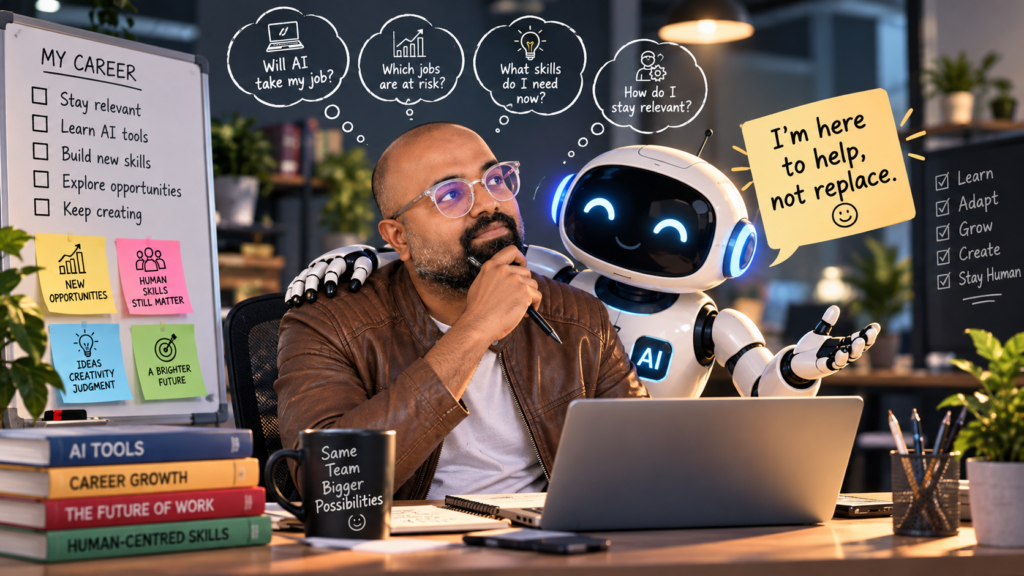
If you have spent any time online lately, you might think AI is coming for everyone’s job.
Writers, designers, marketers, programmers, accountants, customer-service agents… the list seems endless.
But there is a difference between AI changing a job and AI eliminating a job. And when you look beyond the headlines, the numbers tell a more interesting story.
Here are five statistics worth knowing.
#1 – One in four workers is exposed to generative AI. Most jobs are still expected to be transformed, not replaced.
According to the International Labour Organization’s research on generative AI and jobs, one in four workers globally is in an occupation with some exposure to generative AI.
That sounds alarming until you read the second half of the finding.
The ILO says that, because most occupations still require human input, transformation is the more likely outcome than outright replacement.
In other words, AI may change what you do at work without making your entire job disappear.
AI exposure ≠ job replacement.
#2 – Workers using AI became 14% more productive
This one is particularly interesting.
A National Bureau of Economic Research study of 5,179 customer-support agents found that workers given access to a generative AI assistant became 14% more productive on average. For newer and lower-skilled workers, the improvement was around 34%.
The AI wasn’t sitting in a corner doing the entire job.
It was helping people do their jobs better.
That points to a different future of work: AI as a tool that amplifies human ability, rather than simply replacing it.
#3 – 170 million jobs could be created while 92 million are displaced
The World Economic Forum’s Future of Jobs Report 2025 estimates that labour-market changes between 2025 and 2030 could create 170 million jobs and displace 92 million, producing a net increase of 78 million jobs.
There is an important footnote: these numbers aren’t caused by AI alone. The WEF includes technological change, demographic shifts, economic conditions, and other major trends.
Still, the bigger lesson matters. Jobs can disappear while new jobs emerge.
The future of work isn’t necessarily a shrinking pie. It can be a pie with different slices.
#4 – 65% of U.S. workers still don’t use AI much or at all at work
The AI revolution can feel much further along when you’re reading about it online.
The reality is different.
A September 2025 Pew Research Center survey found that 65% of U.S. workers said they don’t use AI much or at all in their jobs. At the same time, 21% said at least some of their work is done with AI.
AI adoption is clearly growing. But the workplace hasn’t suddenly become a giant room full of humans watching robots do their jobs.
We’re still very much in the transition.
#5 – Four out of five workers say AI improves their performance
Here’s perhaps the most revealing number.
An OECD study on AI in the workplace found that four out of five workers said AI improved their performance at work. Three out of five also said it increased their enjoyment of work.
That’s not what a simple “humans versus machines” story looks like.
For many workers, AI is becoming another tool in the toolbox: something that helps with research, analysis, writing, coding, administration and countless other tasks.
So, will AI take your job?
Some jobs will disappear. Some tasks will be automated. And some occupations will change dramatically.
Pretending otherwise would be just as misleading as claiming AI is about to take everyone’s job.
The numbers point to something more nuanced.
AI is likely to change your work before it replaces your work. And that leaves us with a more useful question than “Will AI take my job?”
What can I do that becomes more valuable when AI is part of the team?
That is probably the question worth preparing for.
FAQs
1. Will AI take my job?
AI is likely to change many jobs, but current research suggests that transforming jobs and automating individual tasks is more common than completely replacing occupations.
2. How many jobs are at risk from AI?
The ILO estimates that one in four workers globally is in an occupation with some exposure to generative AI. However, it says transformation is more likely than outright replacement for most jobs.
3. Is AI replacing jobs or creating jobs?
Both are happening. The World Economic Forum projects 170 million jobs could be created and 92 million displaced by 2030 due to major labour-market trends, including technological change.
4. Does AI make workers more productive?
Yes. One major study found that generative AI increased customer-support worker productivity by 14% on average, with larger gains among newer and lower-skilled workers.
5. How many workers currently use AI at work?
In a September 2025 Pew Research Center survey, 21% of U.S. workers said at least some of their work was done with AI, while 65% said they used AI little or not at all.
6. What jobs are most at risk from AI?
Jobs with many routine, predictable, and digitized tasks generally have greater exposure to generative AI. However, exposure does not automatically mean the entire occupation will disappear.
7. What should I do to stay relevant as AI develops?
Learn how AI can improve the work you already do, while strengthening skills that depend on human judgment, creativity, communication, collaboration, and decision-making. The goal is not to compete with AI at everything. It is to become better at working with it.