You’ve prepared your resume. You’ve read the job description three times. You’ve even rehearsed your answer to “Tell me about yourself.”
And yet, five minutes before the interview, your heart starts racing.
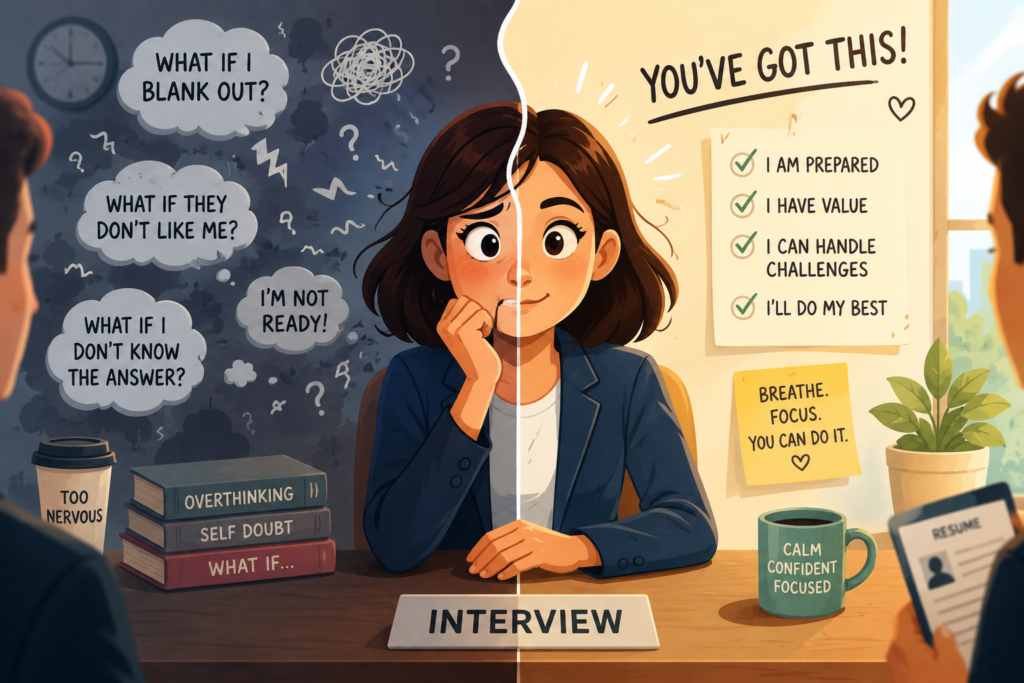
Suddenly, you’re wondering:
What if I forget everything? What if I say something stupid? What if they ask me something I don’t know?
Sound familiar?
You’re not alone. A 2024 iHire survey found that 24.4% of job seekers identified interview anxiety as a source of job-search stress. And a 2024 LinkedIn article citing JDP research reported that 93% of candidates experience anxiety before a scheduled interview.
So, first things first: being nervous doesn’t mean you’re bad at interviews.
It usually means you care about the outcome.
Why Do Interviews Make Us So Nervous?
Interviews are a strange situation. You’re sitting across from someone you probably don’t know, trying to convince them that you’re good enough for a job.
There’s uncertainty. There’s judgment. And, let’s be honest, there’s rejection hanging somewhere in the background.
Your brain can turn that into a much bigger threat than it actually is.
The good news? You don’t have to completely eliminate your nerves.
The goal is to stop your nerves from taking over.
Here’s how.
Prepare, But Don’t Memorize
Preparation gives your brain something familiar to hold on to.
- Research the company.
- Understand the role.
- Go through common interview questions.
- Think about a few projects, achievements, and challenges you can talk about.
But don’t memorize entire answers word-for-word.
If you do, forgetting one sentence can make your whole answer collapse.
Instead, remember key points.
For example, for “Tell me about yourself,” remember: Current role → experience → key achievement → why this role
Now you’re having a conversation, not reciting a speech.
Practice With a Real Person
Reading interview questions silently isn’t the same as answering them out loud.
Ask a friend to interview you.
Tell them to throw in one unexpected question too. You might stumble at first. That’s actually useful.
Because it’s much better to discover that you tend to ramble while practising with a friend than while sitting across from the hiring manager.
Indeed also recommends mock interviews and practising answers as ways to build confidence and reduce anxiety.
Give Yourself Permission to Pause
One of the biggest interview myths is that confident people answer immediately.
They don’t.
If you need a moment, take it.
Try: “That’s a good question. Let me think about that for a moment.”
Then breathe and answer. A two-second pause can feel like ten seconds inside your head. To the interviewer, it usually just looks like you’re thinking.
Stop Treating the Interview Like an Exam
This mental shift can make a huge difference.
You’re not sitting for a test where one wrong answer means you’ve failed. You’re having a professional conversation to see whether you and the company are a good fit.
That doesn’t mean the interview isn’t important. It means you don’t need to perform like a robot.
Be curious. Listen carefully. Ask questions.
And remember: they invited you for a reason.
Deal With the Physical Nerves
Sometimes your mind isn’t the biggest problem. Your body is.
- Your hands are sweaty.
- Your shoulders are tense.
- Your breathing is shallow.
Before the interview, take a few slow breaths. Relax your shoulders. Go for a short walk. Drink some water.
Indeed recommends breathing exercises, physical movement, and reducing last-minute stressors as practical ways to manage interview anxiety.
Even something as simple as arriving ten minutes early can help. You’re much less likely to panic when you’re not sprinting into the building.
Remember What You Bring to the Table
This is the part people often forget.
You spend so much time thinking about whether they will choose you that you forget to think about what you can offer them.
Before the interview, write down three things you’re genuinely good at.
- Maybe you’re great at solving problems.
- Maybe clients trust you.
- Maybe you’ve led projects successfully.
Whatever it is, remind yourself.
Confidence doesn’t mean walking into an interview thinking you’re the best person in the world.
It means walking in thinking: “I have something valuable to offer. Let me show them what that is.”
And that’s a much more realistic kind of confidence.
If you’d like to build on this, read our guide on 6 Practical Ways to Boost Your Confidence in an Interview Process.
